
WW3? Israel Attacks Iran In Full Assault
Saturday morning. While most of America slept, the world shifted on its axis.
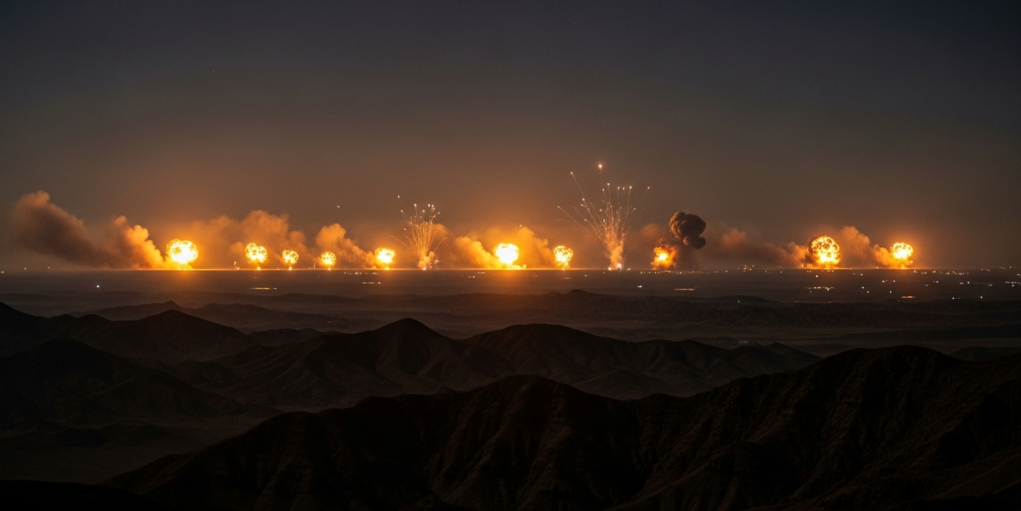
Israel announced it had struck “hundreds of targets” across western Iran as part of a joint U.S.-led military operation codenamed “Operation Roaring Lion.” The targets weren’t random military installations or empty warehouses hit for show. They went for the throat — missile launchers, defense infrastructure, intelligence facilities, and the personal compounds of Iran’s most powerful leaders.
The Supreme Leader’s compound. The President. The head of the Revolutionary Guard. Defense and intelligence chiefs. All targeted. All in one coordinated morning.
This wasn’t a warning shot. This was an answer.
Forty-Seven Years in the Making
Benjamin Netanyahu’s address to the nation Saturday carried the weight of nearly half a century. “For 47 years, the Ayatollah regime has called out ‘Death to Israel’ and ‘Death to America.’ It has shed our blood, murdered many Americans, and massacred its own people.”
No diplomatic qualifiers. No “both sides” hand-wringing. Just a prime minister standing in front of his country and stating, plainly, that the regime that has funded terrorism across the globe, pursued nuclear weapons, and promised genocide finally got the response it spent decades begging for.
And standing right beside Israel in this operation was the United States, under a president who doesn’t believe in half-measures.
Netanyahu thanked Trump for his “historic leadership.” That phrase is doing a lot of heavy lifting, but it’s earned. Previous administrations sent pallets of cash to Tehran. Trump sent something else entirely.
The Target List
The scope of this operation is staggering. The Israeli Defense Forces confirmed strikes on hundreds of targets across western Iran, focusing on the missile program infrastructure that has kept the entire Middle East on edge for decades.
But it’s the leadership targeting that signals the true intent. Satellite imagery published by the New York Times appears to show the destruction of Ayatollah Khamenei’s personal compound. Whether he was inside at the time remains unknown as of this writing. Iran’s president, the head of the Revolutionary Guard, and the defense and intelligence chiefs were all reportedly in the crosshairs.
When you target a country’s missile launchers, you’re degrading capability. When you target the Supreme Leader’s compound, you’re sending a message that goes far beyond military strategy. You’re telling a regime — and its people — that the men at the top are no longer untouchable.
The Call to the Iranian People
Here’s where Netanyahu’s speech went from military briefing to something historic. He didn’t just announce strikes. He issued an invitation.
“Our joint action will create the conditions for the brave Iranian people to take their destiny into their own hands.”
Then he did something no Israeli leader has done with this kind of force and specificity — he spoke directly to Iran’s ethnic groups. “The time has come for all parts of the Iranian people — the Persians, the Kurds, the Azeris, the Baloch, and the Ahwazi — to cast off the yoke of tyranny and bring about a free and peace-seeking Iran.”
That’s not a military communiqué. That’s a liberation speech. He’s telling every oppressed group inside Iran’s borders that the regime’s grip is weakening and the window is opening. Whether they seize it is up to them, but the conditions are being created from the outside in a way they haven’t been since 1979.
The Nuclear Equation
Netanyahu made the stakes explicit: “This murderous terror regime must not be allowed to arm itself with nuclear weapons that would enable it to threaten all of humanity.”
That sentence contains the entire strategic justification. Iran has been sprinting toward nuclear capability for years. The Obama-era deal was supposed to slow that race — instead, it funded it. Every year of diplomatic patience bought Tehran another year of centrifuge development, another step closer to a weapon that would make the regime untouchable and the Middle East permanently unstable.
Trump pulled out of the Iran deal in his first term because he saw what the foreign policy establishment refused to admit — you can’t negotiate with a regime that views your destruction as a religious obligation. Now, in his second term, the policy has shifted from economic pressure to kinetic reality.
The message to Tehran is no longer “we’d prefer you stop.” It’s “we’re stopping you.”
The Trump Doctrine in Action
This is what peace through strength actually looks like. Not the bumper sticker version. The real thing.
Trump’s approach to the Middle East has been consistent from day one — strengthen allies, punish enemies, and never bluff. The Abraham Accords redrew the diplomatic map. The cartel operations in Mexico showed he’d use force in the Western Hemisphere. The Venezuela drug boat campaign demonstrated reach. And now, a joint U.S.-Israeli operation targeting the heart of the Iranian regime shows the world that American military power under this president isn’t theoretical.
While previous administrations debated, sanctioned, and sent John Kerry to negotiate over lunch, Trump and Netanyahu coordinated a strike package that hit the Supreme Leader’s house.
That’s not escalation. That’s clarity.
Where This Goes
The next 48 hours will determine the immediate fallout. Did the leadership strikes find their targets? How will Iran’s fractured military respond? Will the ethnic groups Netanyahu addressed find the courage — or the opportunity — to move?
The regime in Tehran has survived for 47 years through brutality, propaganda, and the quiet cooperation of Western governments too afraid to act. That cooperation ended this morning.
Whether this is the beginning of the regime’s end or the start of a dangerous new chapter depends on what happens next. But one thing is already settled — the era of America and Israel absorbing threats from Iran without consequence is over.
Netanyahu called it Operation Roaring Lion. After 47 years of “Death to America” and “Death to Israel,” the lion finally roared back.